
The Short Version
- Miami-Dade’s online electrical permitting may be limited to qualified contractors, so confirm the homeowner filing route before assuming online access.
- Cord-and-plug units that are not connected to the building’s electrical system and use an existing outlet may not need an electrical permit if no circuit, outlet, or hardwiring is added or modified—but confirm locally.
- Adding a new circuit or outlet may trigger an electrical permit depending on local rules; many Florida counties require one for that work.
- Recessed installs that open walls may need electrical and structural permits depending on what’s behind the drywall and local building review.
- Inspection scheduling windows vary by county; some counties require advance notice and limit when inspectors can be reached.
- Skipping a permit for work that requires one can leave no official record showing what was changed or inspected; confirm any permit exemption with the local building department before relying on it.
- Some counties may offer simplified review for smaller electrical jobs, but structural changes still follow the local building-permit process.
Why This Comes Up
Homeowners pick wall-mounted electric fireplaces for practical reasons. No chimney, no gas line, no wood, no ash. They mount flush, which helps in Tampa Bay condos and older ranch homes where floor space is tight. These units come up during kitchen remodels, living room updates, and full-home renovations, and the flexibility is part of why people choose them over wood-burning or freestanding options.
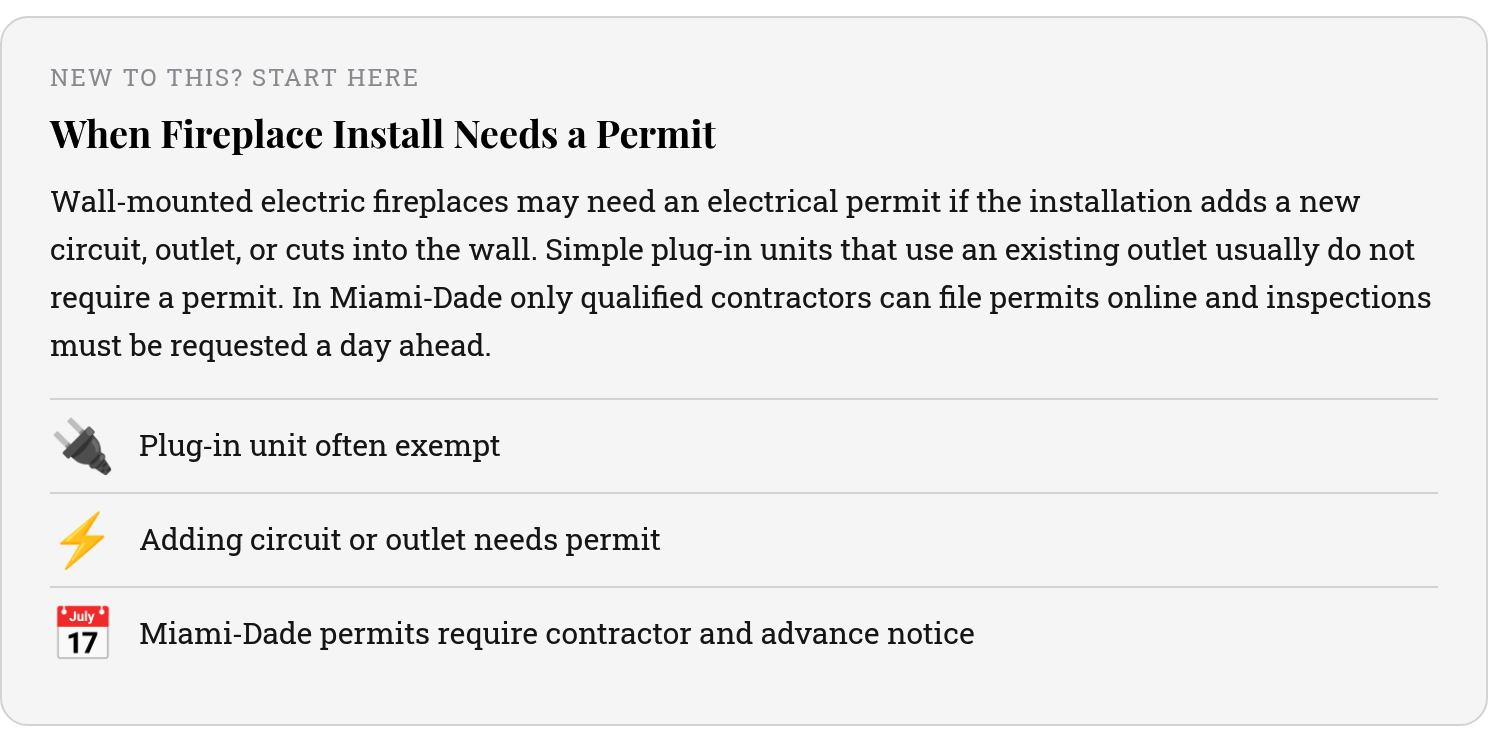
The electrical side catches people off guard. Depending on the unit and your home’s wiring, installation may mean adding or modifying a circuit. Florida counties regulate that work through permits. Miami-Dade’s electrical permit page cites fire and electrocution risks as reasons permits exist. Orange County has one too. The question for your install is simple: does the circuit work cross the permitting line?
Miami-Dade Limits Who Can File
In Miami-Dade, electrical permits are handled through the county’s building-permit process. The county’s e-permitting system may only allow qualified contractors to apply, pay fees, and print permit cards. Homeowners filing as owner-builders should confirm whether online filing is available for their project.
Skipping Paperwork Creates Gaps
If you add a circuit, documenting it matters. Inspection request and inspector-contact windows vary by county; some counties require advance scheduling and limit phone availability. Keep approved plans and the permit card on site. Before assuming your install is exempt, check the county’s exemption rules. Skipping paperwork now may mean no record when you later need to show what was inspected.
Installation Paths and What They Trigger
In Miami-Dade, start by confirming the filing route before work begins. For wall-mounted electric fireplaces, the installation path determines who can pull the permit and what the process looks like.

Three paths cover most residential installs. Each sits in a different place on the permit-trigger spectrum.
Plug-in, no wiring changes to the building’s electrical system. The unit is cord-and-plug equipment using an existing outlet. Verify the circuit can handle the load. If no circuit, outlet, or hardwiring is added or modified, a permit may not be required, but confirm with the local building department because county rules vary.
Surface-mounted with a new or existing outlet. If you’re adding a new circuit or outlet, that electrical work can trigger a permit. Some counties may also require a Notice of Commencement depending on the total value of the work. Confirm local filing requirements before the electrician runs wire.
Recessed with a wall cut-out. Opening the wall adds framing review to the electrical question. Some counties may offer simplified electrical review for smaller electrical jobs, but structural modifications still follow the county’s full building-permit process. A load-bearing wall or moisture-damaged framing adds another review layer.
Use this table as a starting point, not a statewide rule. Every county has its own requirements.
| Installation Type | Local Permit Check | Electrician Review | GC/Structural Review | Notes |
|---|---|---|---|---|
| Plug-in, no wiring | Check first | Not required | Not required | Verify circuit capacity |
| New outlet or circuit | Confirm locally | Recommended | Not required | Check local NOC requirements |
| Recessed, wall cut-out | Confirm locally | Required | Depends on wall type | Load-bearing or framing review possible |
If the fireplace install is part of a larger renovation that already has a building permit, confirm how the electrical work should be filed under that permit—standalone trade permits and subsidiary permits are handled differently depending on the county.
Simple plug-in installs with no wiring changes carry the least permit risk. Any new circuit work, recessed installation, or wiring upgrade warrants a direct check with the local building department before work starts.
When You Need a Licensed Electrician
The line between “you can pull this permit yourself” and “you need a licensed electrician” is where most homeowners get stuck. Florida counties may give owner-builder latitude in some cases, but that latitude has limits.
Some Florida counties allow a homeowner to act as their own contractor under owner-builder rules, but that usually comes with disclosure requirements. It may get you the permit; it doesn’t mean complex electrical work is safe to do yourself. If the fireplace needs a new circuit, a dedicated receptacle, hardwiring, or panel work, those are the points where Flippin’ Rustic Construction coordinates a licensed electrician rather than treating the job as an owner-builder filing.
When to Stop and Call an Electrician
A few situations shift this from DIY-friendly to a call. If the wall cavity shows moisture damage when opened, the electrician should pause and Flippin’ Rustic coordinates a remediation specialist before any wiring goes in. Installations near bathrooms, kitchens, exterior walls, garages, or lanais need an electrician’s review since wet and damp locations carry protection requirements that depend on the current code and local amendments.
What to Discuss Before Power-On
Before power-on, walk through a checklist with your electrician: breaker size, wire gauge, grounding, circuit capacity, receptacle location, and manufacturer instructions. Confirm the work is inspection-ready and that the inspection request window is known in advance.
Your electrician can also explain how the county handles inspection requests, owner-builder paperwork, and any Notice of Commencement tied to the project. Keeping those responsibilities clear prevents a finished installation from waiting on an overlooked filing. Depending on scope and project value, a Notice of Commencement may be required before work starts. The contractor or local permitting office can confirm whether your project triggers one.
What Happens When You Skip Permits or Use Unlicensed Help
Missing the window can leave a job waiting until the next available appointment. Confirm the local path before work starts.
If a contractor suggests you pull the permit yourself through Miami-Dade’s online portal, confirm the proposed filing method with the county before proceeding.
Some electrical work triggers a Notice of Commencement filing requirement depending on project value and local rules. It’s a separate step that catches people off guard, especially when the scope includes both wiring and materials. A meter reset permit is a separate stand-alone filing the utility may require before restoring service after it has been off. These can be separate permits, not one.
Red Flags on Fireplace Projects
These are the signals something is off:
- The contractor won’t provide license or insurance documentation
- They can’t explain who will schedule inspections or handle county filings
- They push you to sign documents without explaining the content
Some counties require a licensed contractor to grant Power of Attorney to an agent for permitting purposes, and the document may need to be original, site-specific, and notarized. A blanket authorization form may not meet that standard. Verify the local form before relying on it.
Before any recessed install, if the wall shows staining, soft drywall, musty odors, swelling, or visible growth, the project pauses until moisture or mold is ruled out. If the cut may be in a load-bearing wall, that triggers a building-department and GC review before work proceeds—Flippin’ Rustic coordinates that review.
How We Handle Permits and Electricians
Before we start a wall-mounted electric fireplace project, we figure out what the install actually requires. Wall condition, whether it’s load-bearing, moisture levels, and circuit capacity all matter. Those details determine whether the job is a simple plug-in using an existing outlet or needs a permitted electrical alteration. The answer changes who does the work and how fast it moves.
Once we know the install type, we map out the permit path. For recessed or surface-mounted units requiring new wiring, we pull the permit as the licensed contractor. We build the schedule around inspection timing and inspector availability. Inspection turnaround varies by county and season, so we confirm the local request window and build in a buffer when setting homeowner expectations.
How We Coordinate the Electrical Work
We bring in a licensed electrician when the scope calls for one. We recommend homeowners verify the electrician’s license and insurance independently. We handle scheduling and inspection timing.
If an agent needs to pull the permit on behalf of the contractor, some counties require a licensed contractor Power of Attorney that is original, site-specific, and notarized. That kind of paperwork matters for keeping a project from stalling at the permit counter. If the home’s power has been off for any reason, a standalone meter reset permit may also be required before the utility restores service. That one catches homeowners off guard when the timeline is tight.
Our role is scope review, permit handling, trade coordination, and documentation. If you want to talk through what your project looks like, we can walk through it in a free consultation.
References
[1] Electrical Permits – Miami-Dade County – https://www.miamidade.gov/global/economy/building/permits/electrical.page
[2] Electrical Permit – Orange County Government Florida – https://www.orangecountyfl.net/PermitsLicenses/Permits/ElectricalPermit.aspx
Common Questions
Can I install a wall-mounted electric fireplace myself if I’m handy, or do I need a licensed contractor?
You can generally install a cord-and-plug unit that uses an existing outlet and is not connected to the building’s electrical system without hiring a contractor, provided the unit and location meet local requirements. New wiring, hardwiring, panel work, or cutting into a wall calls for a permit and trade review. In Miami-Dade, confirm the filing route before assuming you can submit the electrical application online.
What happens if I skip the permit and something goes wrong later?
If you skip a permit for work that requires one, you may have no official record showing what was changed or inspected. When the scope includes a new circuit, wall cut-out, or possible load-bearing framing, Flippin’ Rustic coordinates the electrician, permit, inspection, and GC review so the record reflects the work.
How do I know if my existing outlet can handle the fireplace load, or if I need a new circuit?
Start with the fireplace’s wattage rating and the circuit information in the home’s panel. Consider what else shares that circuit, particularly heaters, kitchen equipment, or other high-draw devices. An electrician can test the circuit, check the receptacle and wiring, and determine whether the fireplace should have its own circuit.