
Related Video
Watch: Top 5 Best Home Renovation Loans in 2025 (No-BS Guide!) by My Boys Contracting
What You Need to Know
- HELOCs let you borrow against home equity, with variable rates and draw periods that vary by lender.
- Personal loans for renovations vary by lender, with rates based on credit profiles.
- FHA 203(k) limited loans handle smaller repairs, while standard versions cover major structural work.
- HomeStyle and 203(k) loans release funds in escrow draws as contractors hit milestones, while personal loans can fund fast as a lump sum.

How Tampa Bay Homeowners Actually Fund Remodels
Homeowners approach renovation funding in two broad categories. Those with significant equity tap their homes through HELOCs or home equity loans. Those without enough equity—or who won’t risk collateral—use personal loans, credit cards, or government-backed programs. With limited equity, many homeowners start with unsecured options such as personal loans or credit cards, then move to a HELOC or home equity loan after building enough equity. Eligibility and lender limits vary, so confirm the details before committing. Your path depends on three factors: equity position, acceptable interest rate, and whether you need a lump sum or staged access.
Equity-backed borrowing: lines vs. loans
A HELOC is a line secured by your house. You draw what you need, and the balance changes as you repay it. Rates are variable, so monthly payments can shift. This structure fits phased kitchen or bathroom projects when final costs are still developing and invoices arrive at different points.
A home equity loan delivers a fixed lump sum with a fixed rate and set monthly payments. If your remodel will cost $40,000 and you want that committed upfront, this is easier to budget than a revolving line. Both options may let you deduct interest if the funds go toward home improvements—confirm that with your tax advisor before filing. Both require enough equity in the property.
Non-equity loans: faster but higher cost
Personal loans don’t require collateral. The lender deposits the approved amount, you repay through scheduled installments. Some lenders fund approved borrowers quickly, which can help with urgent work or contractor scheduling.
Credit cards suit smaller projects when you can clear the balance quickly. Some offer promotional financing, but rates can spike once the promo period ends. If you’re painting a bedroom or replacing a water heater and can pay it off within the promotional window, workable. For a $30,000 kitchen gut, the interest risk is much higher.
Government renovation loans for fixer-uppers
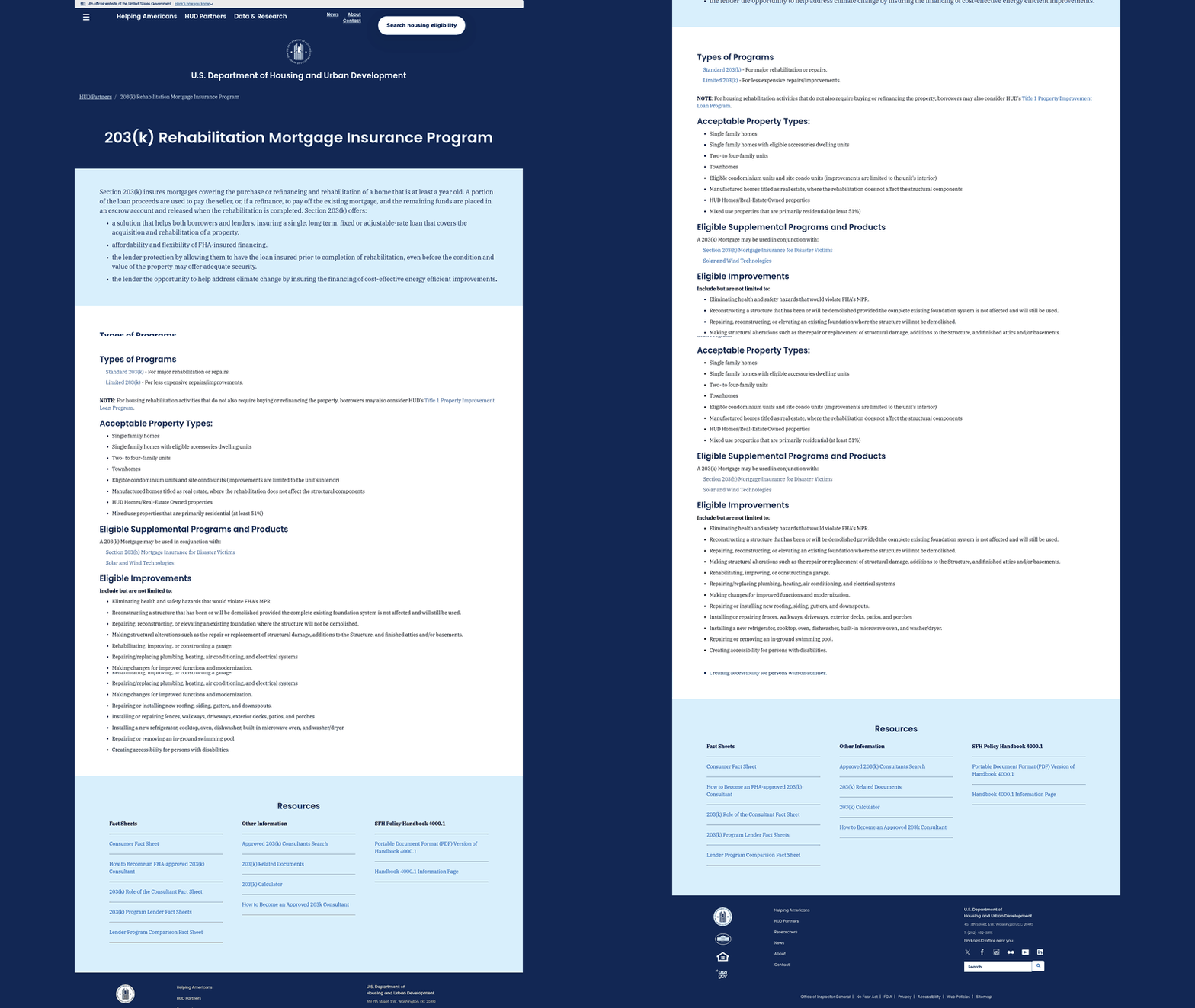
FHA 203(k) loans roll acquisition and renovation costs into a single mortgage. Useful if you’re buying a fixer-upper in Hillsborough or Pinellas. The limited 203(k) handles smaller repairs—cosmetic work, minor systems updates—capped at $35,000. The standard 203(k) covers major projects with no upper limit and requires a HUD consultant to oversee the work. Fannie Mae HomeStyle loans let you finance eligible improvements as part of a purchase or refinance, subject to program limits. These programs use controlled disbursements. Funds sit in escrow until work is documented and approved.
Contractor-linked financing: read the fine print
Some contractors offer installment plans, typically by partnering with lenders who structure payments around project milestones. If a contractor presents financing, look for the APR, whether the lender holds funds until inspections are complete, and what happens if the project runs over budget. Verify the offer comes from a recognized lender—not a verbal promise—before signing anything.
| Financing Type | Typical Loan Amount | Repayment Term | Rate Structure | Equity Required | Funds Delivered |
|---|---|---|---|---|---|
| HELOC | Up to 85% LTV minus mortgage | 10-year draw + 20-year repay | Variable | Varies by lender | Revolving draw |
| Home Equity Loan | Up to 90% LTV minus mortgage | 5–30 years | Fixed | Varies by lender | Lump sum |
| Personal Loan | $3,000–$100,000 | 12–84 months | Fixed | None | Lump sum |
| Credit Card | Varies by limit | Revolving | Promo 0%, then ~21% | None | Revolving |
| FHA 203(k) | No cap (standard); $35k cap (limited) | Up to 30 years | Fixed | Varies by lender | Escrow draws |
| HomeStyle | 75% of price + costs or as-completed value | Up to 30 years | Fixed | Varies by lender | Escrow draws |
The right choice depends on your credit score, equity position, and whether you’re buying a property or refinancing one you already own. If you’re unsure which route fits your kitchen or bathroom project, we can walk through scope and budget in a free consultation.
What to Have Ready Before You Apply
Before comparing loan products, answer two questions: what are you building, and what will it cost? Some homeowners lock in financing first, then find the project exceeds the loan amount. Others get three contractor bids that vary wildly because scope was never defined. Neither works.
Write out every detail before talking to lenders
List every room, surface, and system you plan to touch. A kitchen remodel might include cabinets, countertops, appliances, plumbing updates, electrical work, and flooring—but does it also include moving a wall, adding a window, or relocating the range? Each decision shifts budget and timeline. If you’re removing or moving a load-bearing wall, you’ll need an engineer’s stamp and a permit, adding time and cost. Lenders reviewing renovation loan applications want detailed scope that accounts for structural work, not vague wish lists.
Get written estimates from at least two licensed contractors. Ask them to break out labor, materials, and permits separately so you can compare line by line. Some contractors include a contingency line to cover surprises like rotted framing or outdated wiring. That’s normal. Others leave it out, which means the first surprise triggers a change order—a documented adjustment to agreed scope, price, or timeline. Example: you chose standard quartz in the original bid, then after demo you upgrade to premium slab, adding to the total. Lenders want to know how change orders will be handled. Some renovation loan programs hold funds in escrow and release them only as each stage completes and passes inspection.
We provide a line-item estimate that separates materials, labor, permits, and contingency, along with a timeline showing when each phase completes. That level of detail gives lenders confidence to approve and gives you clarity to avoid mid-project funding gaps. If you’re applying for a HomeStyle or FHA 203(k) loan, expect the lender to require contractor licensing verification, proof of insurance, and documentation tying budget to planned work. Those requirements protect you as much as the lender.
Walking Through the Application
Once you’ve decided which financing path makes sense, the next step is comparing actual offers and submitting applications. Some homeowners apply to multiple lenders at once to compare rates side-by-side. Others start with their primary bank and branch out only if terms disappoint. Either works, but casting a wider net early typically nets a better rate.
Compare offers and pull together documents
Check what pre-qualification looks like at each lender. Some personal-loan providers let you see estimated rates with a soft credit pull. If you’re comparing a HELOC or home equity loan, expect a harder pull once you move past the rate-check stage. Those products require home appraisals and title verification. The appraisal alone can add a week or more.
Most lenders ask for proof of income, such as pay stubs, tax returns, or bank statements. For equity-based products, they’ll also want your existing mortgage statement and a recent property tax bill. Have those ready before starting, since delays providing documents are the most common reason applications stall.
Submit and wait for a decision
Personal-loan timelines move fastest. Some lenders fund approved borrowers within a day or two of signing because there’s no collateral to verify. The lender mainly needs to confirm income and creditworthiness.
HELOCs and renovation loans take longer. The lender has to confirm your home’s current value and verify that the contractor you’re hiring is licensed and insured. Lenders may ask for your contractor’s license number and proof of general liability coverage before approving. Renovation products can require additional review of plans, budget, and property after application submission.
If you’re considering milestone-linked payments—paying the contractor only after each phase completes—ask whether your lender supports that approach or releases the full amount upfront. Personal loans give you one lump sum, so you manage contractor payments yourself. With an equity-backed line, coordinate timing of each draw with your invoice schedule so money is available when actually needed.
Where Homeowners Run Into Trouble
Homeowners sometimes misjudge scope, underestimate total costs, or pick a funding structure that doesn’t match how contractors actually get paid. A HELOC might offer the lowest rate, but if your contractor expects lump-sum payment upfront and you’re drawing in stages, you’ve introduced friction that costs time and trust.
Look at total cost, not just the advertised rate
Origination fees on personal loans add upfront cost. Home equity loans typically skip origination fees but may carry appraisal and closing costs similar to a mortgage. Cash-out refinancing replaces your entire mortgage at today’s rate. If you locked in a lower mortgage rate, a HELOC or home equity loan may be a better fit than cash-out refinancing because a second-lien product leaves your current mortgage in place while cash-out refinancing resets the rate on the full balance. Compare total cost over the life of the loan, including every fee and the interest you’ll actually pay, not just the advertised APR.
A variable-rate HELOC starts attractive but can shift mid-project. That swing matters when you’re already managing contractor invoices and material delays.
Build in room for scope changes and verify what the estimate actually covers
Tampa renovations can surface surprises—outdated plumbing behind a wall, a load-bearing beam that can’t be moved without engineering, or a permit requirement nobody anticipated. Borrowing exactly what the initial bid states leaves no cushion. Budget for unknowns without tying yourself to a fixed contingency percentage, since every project’s risk profile differs.
Before borrowing, confirm what the written estimate includes and what it excludes. Ask whether appliances, fixtures, and finish materials are included or listed as allowances—dollar amounts the contractor sets aside that you’ll spend separately. Clarify the change-order process: how additional work gets priced, approved, and added to the total. A transparent, itemized estimate that spells out exclusions and allowances protects you from funding gaps that force you to tap credit cards or halt work.
Verify your contractor holds a valid fl contractor license (Florida contractor license)—check the state database by license number—and carries current liability and workers’ compensation insurance. Unlicensed work isn’t just a legal risk. It typically means no permit, no inspection, and no recourse if the job goes sideways. If you’re comparing contractors and one offers milestone-linked payment terms, confirm your lender permits staged disbursements before committing to that approach.
References
[1] Fixing Up Your Home and How to Finance It – HUD – https://www.hud.gov/hud-partners/single-family-fixing-home
[2] How to Pay for Home Improvements — With or Without Equity – NerdWallet – https://www.nerdwallet.com/home-ownership/home-improvement/learn/finance-home-remodel-without-equity
[3] How home improvement loans work and financing options – U.S. Bank – https://www.usbank.com/financial-education/borrow/home-improvement-loans-financing-options.html
[4] Best Home Improvement Loans in 2026 – WSJ – https://www.wsj.com/buyside/personal-finance/personal-loans/home-improvement-loans
[5] Financing a Home Renovation: What Construction Loan Is Best? – Hometap – https://www.hometap.com/blog/home-renovation-loans
[6] 9 Strategies to Help Finance Your Dream Home Remodel – Synchrony – https://www.synchrony.com/blog/banking/how-to-finance-remodel
[7] Home Improvement Loans | Wells Fargo – https://www.wellsfargo.com/personal-loans/home-improvement/
[8] HomeStyle Renovation – Fannie Mae Single Family – https://singlefamily.fanniemae.com/originating-underwriting/mortgage-products/homestyle-renovation
[9] Understanding Renovation Loans for First-Time Homebuyers – Chase Bank – https://www.chase.com/personal/mortgage/education/buying-a-home/renovation-loan-first-time-home-buyer
[10] HELOC, Cash-Out Refinance or Home Equity Loan? – Bankrate – https://www.bankrate.com/home-equity/home-equity-loan-heloc-or-cash-out-refi/
[11] Top 5 Best Home Renovation Loans in 2025 (No-BS Guide!) by My Boys Contracting – https://www.youtube.com/watch?v=oH8U778kD6Q
Quick Questions, Straight Answers
Can I use a HELOC to pay a contractor who wants the full amount upfront?
Yes, but you’ll need to draw the entire amount at once and manage payments yourself. Because the contractor is requesting one payment rather than several progress payments, a home equity loan or personal loan may provide a cleaner administrative fit. Before proceeding, confirm that the amount you draw will cover the invoice and that you understand how interest accrues on the balance.
What happens if my renovation costs more than the loan I already took out?
You’ll need to cover the overage with savings, a credit card, or a second loan. Tampa projects can surface hidden issues such as outdated wiring or structural repairs that weren’t visible during planning. Review the estimate for exclusions and allowances before borrowing, and ask the contractor how additional work will be priced and approved.
Do FHA 203(k) loans require me to live in the home during construction?
The home must be your primary residence after the work is complete. FHA 203(k) loans are designed for owner-occupants, so you can’t use them for investment properties or vacation homes. Confirm the construction-period occupancy timeline with your lender; if the renovation makes the home unlivable, ask how that affects draws and when you need to be in the home after work is complete.
Can I deduct interest on a personal loan used for home improvements?
No. Interest on personal loans used for home improvements is generally not deductible. Home equity loan and HELOC interest may qualify only if the funds go toward improvements that add value, and even then you’ll need to confirm eligibility with your tax advisor.