
Exam Paths for a Florida General Contractor License
Florida doesn’t give remodelers one catch-all exam. Each Division I license (General, Building, and Residential) has its own Contract Administration and Project Management exam parts. DBPR publishes a content outline for every construction exam. That means picking the right FL contractor license comes first, because the scope you plan to work in decides which outlines you’ll study.
Your application goes to Professional Testing, Inc., not DBPR. Before you put an exam date on the calendar, check DBPR’s construction exam page for current deadlines and fees. Once you’re approved, you schedule the exam. Check the current format with DBPR. Most are open book and multiple choice.
| Classification | Remodel-relevant scope | DBPR outline documents | CILB form | Scheduling note |
|---|---|---|---|---|
| Certified General | Broadest; trades still subcontracted | Contract Administration, Project Management | 5-A / 6-A | Computer-based, Pearson VUE |
| Building | Commercial and residential within building scope | Contract Administration, Project Management | 5-B / 6-B | Computer-based, Pearson VUE |
| Residential | One- to three-family homes | Contract Administration, Project Management | 5-C / 6-C | Computer-based, Pearson VUE |
| Trade-only (HVAC, plumbing) | Separate licenses; a CGC must subcontract this work unless separately licensed | Trade knowledge | Not covered here | Check DBPR for current exam format and dates |
- CGC fits broad or complex construction.
- Building fits work that stays inside the building-contractor scope.
- Residential fits one-, two-, and three-family work within the limits set by state law.
Height and Structure Decide Most Remodel Licenses
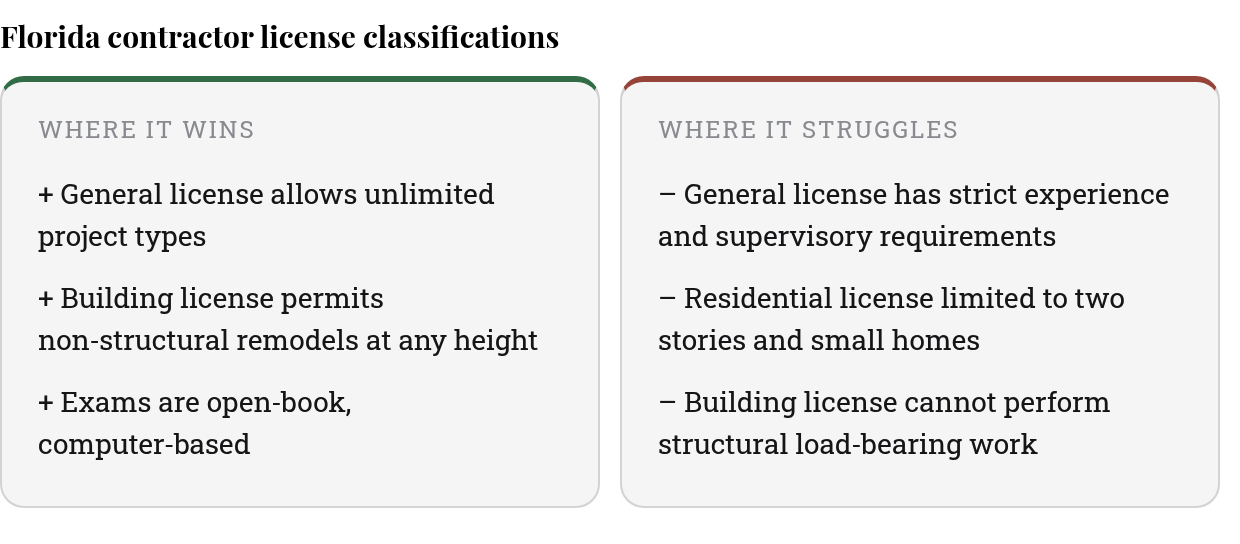
“Load-bearing” means the walls, beams, and columns that hold up the floors and roof above them. On remodel work, two things count more than the name on the license: the type of building, and whether you touch load-bearing parts. A Building license carries no height cap for non-structural remodels. A Residential license stays limited to small homes.
The sources don’t describe these limits the same way. Palm’s scope guide lists no story limit for Residential and lets Building contractors build residential of any size. One licensing guide says Building is limited to commercial buildings of a specified height, and Residential to one-, two-, and three-family homes within statutory height limits.
When sources disagree, we go by DBPR’s construction page, since DBPR is the regulator. Under either reading, a non-structural cabinetry job in a Tampa high-rise condo fits a Building license.
The CGC Experience Rule Can Screen Out Remodelers
The CGC requires four years of experience or an approved mix of education and experience. One licensing guide adds a year as foreman plus new-construction experience, and it counts 2,000 hours as one year. A contractor who has done only finish work, like trim, cabinets, and paint, may have plenty of years but not the kind of years this rule asks for.
Scope First, Then the Outline
Pick the license by the work, not the title. Residential covers small homes: one-, two-, and three-family dwellings. Building often fits interior remodels in larger buildings when the structure isn’t being changed. General is the safer path when a project goes past what the Building classification allows.
Once you’ve chosen, study that classification’s DBPR outlines and file the matching CILB form family (A for General, B for Building, C for Residential). Keep in mind that exam approval, test scheduling, and final licensure are three separate steps. Passing the test doesn’t mean you hold the license.
Which Exam Fits Typical Remodel Work
The number that trips up remodel-focused applicants is two. DBPR’s construction license definitions limit a Residential Contractor to one-, two-, or three-family residences “which are not more than two stories,” plus accessory structures like garages, guest houses, and garden sheds. One school’s scope overview lists the same home types but leaves out the story limit. We follow the regulator’s wording, because your FL contractor license gets measured against the statute, not someone’s summary.
Sort this out before you buy a study guide. A scope mismatch can send you to the wrong prep materials and the wrong application track. It can also leave you holding a license that doesn’t cover the remodel work you plan to sell.
Matching remodel jobs to a Florida contractor license
These scenarios are illustrations, not jobs from our files.
- Kitchen or bathroom remodel in a single-family home. Residential fits when the house stays inside DBPR’s Residential category.
- Detached garage conversion behind a duplex. Residential can cover accessory-structure work tied to an eligible home, as long as the project stays inside that classification’s limits.
- Non-structural interior renovation in a condo tower. This is Building Contractor territory. DBPR allows “remodeling, repair, or improvement of any size building – if the services do not affect the structural elements.” Residential can’t take this building type at any height.
- Structural storm-damage rebuild on a mid-rise building. This points to a General Contractor license. Once load-bearing work goes beyond the Building classification, the broader license becomes the exam path to look at.
The broadest license can be the hardest to qualify for
One CGC licensing guide makes clear that the Certified General path isn’t just a bigger dose of ordinary remodel experience. It expects supervisory history, qualifying project types, and time on construction beyond interior finish work.
If your work stays non-structural and inside homes or condos, we’d skip the CGC. A Residential or Building license covers that work. It’s also the license whose experience requirements you’re more likely to be able to back up on paper.
Trade Licenses vs. A General Contractor License
The word “general” misleads a lot of people. DBPR’s construction license definitions call a general contractor’s services “unlimited as to the type of work.” Yet a Florida CGC licensing guide points out that a general contractor still has to subcontract trade work unless separately licensed or Florida law provides an exception. Subcontracting means hiring a licensed specialist to do that piece of the job. The same guide puts it plainly: “Do not assume ‘general’ means every trade can be self-performed,” meaning done by your own crew.
So we think of a General, Building, or Residential FL contractor license as covering the whole project, not every trade inside it. A trade license works the other way around. It ties the holder to one trade, such as plumbing or air conditioning, and it doesn’t cover running the full remodel.
Trade Licenses Carry Their Own Exams and Limits
Each trade license comes with its own exam and its own limits:
- Plumbing: Plumbing has its own trade knowledge exam. Check DBPR’s exam page for the current format and location.
- HVAC Class B: A Class B license is capped on the size of the cooling and heating systems the holder can work on, according to one school’s scope breakdown.
- HVAC Class A: A Class A license has no system-size or cooling-capacity limit.
That same school lists residential installations among typical Class B projects. For home remodel work, the Class A upgrade tends to matter less than it does for shops going after large commercial systems.
A Bathroom Remodel Can Involve Several Licenses
A bathroom remodel can mix general remodel scope with specialty work: a relocated drain, a new shower valve, a rerouted duct, plus framing, tile, and cabinets. The trade pieces may go to licensed subcontractors. The contractor running the job still needs the right project-level classification.
If you’re a homeowner interviewing contractors, ask two questions. Which license covers the overall project? Who holds the plumbing and HVAC licenses for the trade work? Clear, quick answers to both are a good sign.
You may not need someone running the whole project at all. If you only need a water heater swapped or an AC unit replaced, a licensed trade contractor alone may be the right call. Bringing in a general contractor for that can add cost without adding much. If your project mixes several trades and you’d like help sorting out who does what, we’re happy to talk it through at a free consultation.
How to File Your Application and Book the Exam
Your FL contractor license application starts with a form code, and that code records two choices. According to a Florida CGC licensing guide, the letter sets the classification: CILB 5-A or 6-A for General, 5-B or 6-B for Building, and 5-C or 6-C for Residential. The number sets who’s applying. Use the 5-series if you’re licensing yourself as an individual. Use the 6-series if you’ll be the qualifier for a business, meaning the licensed person responsible for that company’s work.
Your Experience Has to Fit the Letter You Choose
The Certified General path wants experience tied to the kind of work that license allows, not just years spent somewhere in construction. Your application should connect your background to the classification on the form.
The guide also names a common cause of delays. Applicants list job titles without showing their supervisory authority, the project type, the construction phase, structural work, and new-construction experience. “Lead carpenter” doesn’t prove much by itself. Write down what you ran, on what kind of building, and at what stage of the job.
Remodelers run into this a lot. If your years went into cabinets, trim, and interior finish, you may not have the structural and new-construction history the General application asks for. Check your work history against DBPR’s license definitions before you choose a form letter.
Confirm the Exam Steps Before You Plan Your Calendar
DBPR’s construction exam page explains how completed applications and fees go to Professional Testing, Inc. ahead of your exam date. Cutoffs can change, so confirm the current deadline there before you lock in a test date. We don’t list fee amounts here; check the current figures when you apply. After Professional Testing approves you, schedule the exam. Have an email address, a phone number, and payment ready when you book.
Booking the exam is not the same as getting licensed. Other licensing steps still come later. Plan your start date with those steps in mind.
DBPR posts a content outline for each exam on that same page. Start with the Contract Administration and Project Management outlines for the classification your form letter names, then add the Business & Finance outline. Those outlines show which topics the questions can cover, so they’re the best place to start studying this week.
References
[1] Construction Industry – MyFloridaLicense.com – https://www2.myfloridalicense.com/construction-industry/
[2] Florida General Contractor License Guide | Requirements & Exams – https://www.precisionbusinesseducationfoundation.org/florida-general-contractor-licensing-guide
[3] Choosing Your Florida Contractor License: Scope of Work for … – https://palm-school.com/choosing-the-right-florida-contractor-license-scope-of-work-for-common-classifications/
[4] Construction Examinations – MyFloridaLicense.com – https://www2.myfloridalicense.com/examination-information/construction-examinations/
Frequently Asked Questions
Can a Residential contractor remodel a three-story townhome?
Usually, you should look beyond the Residential classification for that project. If the work is purely interior and does not affect structural elements, Building may be the better fit. If the remodel changes load-bearing components outside Building scope, evaluate the General Contractor path.
Do all Florida contractor exams go through Pearson VUE?
No. Plumbing is the notable exception in DBPR’s exam materials, so applicants for that trade should check the current DBPR schedule instead of assuming the same booking process used for the Division I exams.