
Key Takeaways
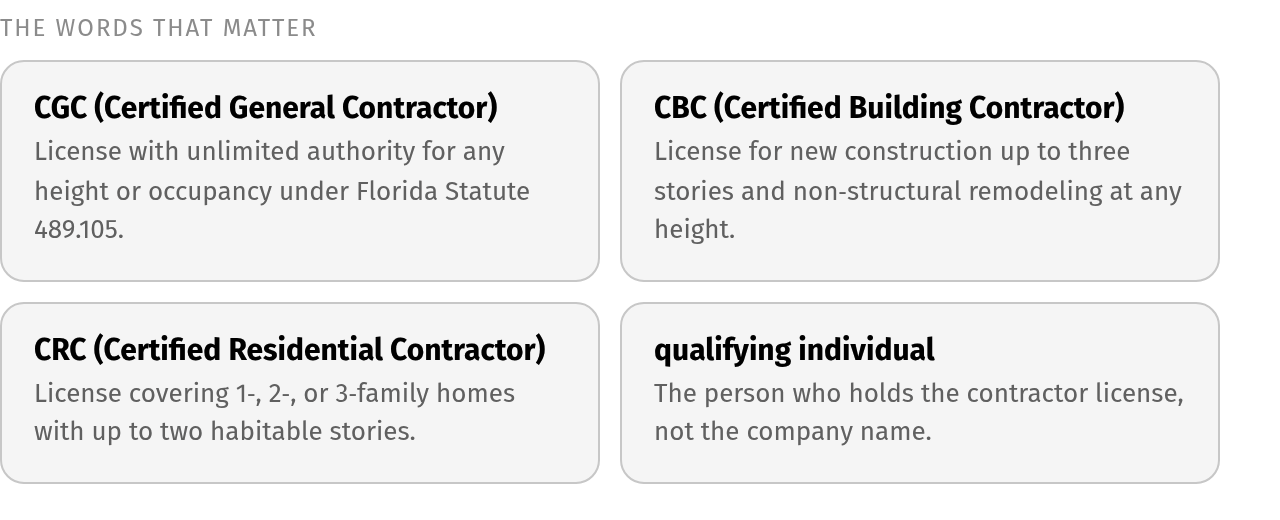
- CGC licenses grant broad authority for many structure heights and occupancy types.
- CBC contractors handle buildings up to three stories for new construction and can perform non-structural remodeling at many heights.
- CRC licenses cover one-, two-, or three-family homes subject to a two-habitable-story limit, with non-habitable levels reviewed separately.
- Hiring unlicensed contractors for permitted work can remove state-level protections.
- The contractor license belongs to the qualifying individual, not the company, requiring verification of on-site personnel credentials.
- Permits get rejected when the contractor’s license class doesn’t match the building’s height, occupancy type, or structural scope.
- Insurance carriers can deny claims when remodeling work proceeds without proper permits from appropriately licensed contractors.
Related Video
Watch: WHAT IS THE DIFFERENCE BETWEEN CBC AND CGC LICENSES? TAMPA GENERAL CONTRACTOR ANSWERS! by Home Love Construction
Florida contractor licenses: what you’re actually checking
Before you sign anything, you need to know whether your contractor can legally pull the permit for your job. That depends on three things: what type of building you have, what you’re changing, and which license class the contractor holds.
This isn’t paperwork theater. If the license doesn’t match the scope, your permit gets rejected. If you’re working with someone unlicensed, you’re exposed—legally and financially. And if the qualifying person on the license isn’t clearly supervising your job, you need to ask how oversight will work.
Start the license review while the scope is still flexible. Once drawings are done and contracts signed, fixing a license mismatch means delays, change orders, or switching contractors entirely.
Which license fits which remodel?
For a full-home remodel or addition, check the building’s occupancy and the proposed height. Single-family may fit a CRC. Taller buildings or different uses may need a CBC or CGC. Kitchen and bathroom remodels are often simpler if you’re staying inside the existing walls, but touching load-bearing structure changes the calculation. Storm rebuilds get evaluated based on what you’re rebuilding and how the original building was classified.
Verify the contractor’s license class and permit authority with your local building department before you lock in the scope. License authority and permit requirements are separate questions. Both have to clear.
Why the license class actually matters
The license determines who can be the contractor of record and whether your permit application describes the work accurately. Get it wrong and you’re looking at corrections, inspection delays, a required contractor change, or surprise subcontracting costs that weren’t in the original budget. Those problems hit hardest when plans are already drawn around a specific builder.
The legal side is worse. Florida treats unlicensed contracting on permitted work as a first-degree misdemeanor. You also lose state protections tied to the licensing system, and your insurance carrier may balk if the work wasn’t properly permitted. This is both a compliance problem and a financial one.
Verify before you finalize scope
Pull the contractor’s license record from the DBPR lookup before you agree to anything. Review it alongside your plans, property use, and the specific work the contractor will supervise.
If the work falls outside that record, resolve it now. The contractor may need a qualified partner, a revised scope, or a different license holder. Get clarification in writing instead of relying on a pitch like “full-service remodeling.”
What each Florida license covers
The CRC (Certified Residential Contractor) isn’t just single-family homes and duplexes. It also covers triplexes when the residence fits the story and habitable-space limits. The relevant factors are the number of dwelling units, how habitable and non-habitable levels are arranged, and what work you’re proposing.
When you’re planning a remodel in Tampa Bay, the license class determines what your contractor can legally build and what permits they can pull. Three tiers: CGC (Certified General Contractor), CBC (Certified Building Contractor), and CRC. Each one narrows the scope.
How the three classes differ
The CGC sits at the broadest end. It has no height or occupancy restrictions. That makes it the go-to class for complex, tall, institutional, or mixed-use work.
The CBC is broader than most homeowners think. Its new-construction authority is tied to a building-story limit, but its non-structural remodeling authority can extend to taller buildings. That distinction matters when a contractor replaces finishes or components without changing the structural frame.
The CRC is aimed at residential properties within its family and story configuration. It is not a substitute for a CBC or CGC on commercial, mixed-use, or taller residential construction.
| License | Scope | Height Limit |
|---|---|---|
| CGC | Unlimited | None |
| CBC | Commercial & residential buildings; non-structural remodeling any height | 3 stories (new construction) |
| CRC | 1-, 2-, or 3-family homes | 2 habitable stories |
Full home renovations and additions: which license you need
When we’re planning a full-home renovation in Tampa Bay, the structural member question matters more than the building’s total height. A CBC-licensed contractor can handle some taller condo remodels when the work stays outside load-bearing walls, beams, columns, and structural floor systems. The plans should establish whether you’re altering an existing building or constructing a new one.
Additions follow a different path because the new work changes the building’s size or configuration. The existing stories, the proposed addition, and how old and new construction connect all belong in the license review. A permit office may also require design documentation or coordination beyond what a finishes-only renovation would need.
When full-home remodels need a CGC
A whole-home remodel that replaces finishes and fixtures—kitchens, bathrooms, flooring, updated systems—may stay within a building contractor’s scope when the structure stays intact. The analysis changes when plans open load-bearing walls, reconfigure floor systems, introduce structural steel, or expand the building envelope.
Waterfront properties can add coordination layers because foundation and site decisions may intersect with coastal engineering and other project requirements. The CGC’s broader technical foundation can be relevant when work extends beyond ordinary interior remodeling.
Match the license to the stamped plans, structural narrative, and permit description before demolition starts. That review is easier and cheaper than changing contractors after work begins.
Kitchen and bathroom remodels: which license is enough
Most kitchen and bathroom remodels focus on finishes, fixtures, cabinetry, and service connections rather than the building’s primary frame. Moving plumbing, upgrading electrical, changing ventilation, or removing a partition can still trigger separate permit and trade considerations. The contractor should identify those elements in the scope instead of treating the room as purely cosmetic.
The license class depends heavily on the property where the work occurs. A project in a condominium or other multi-unit building may also be subject to building management rules, engineering review, access restrictions, and requirements for protecting shared systems. The license question is only part of the preconstruction review.
When the CRC covers the job
A residential contractor may work for a qualifying house, duplex, or triplex when the property fits the CRC definition and the proposed work stays within that residential setting. A large home isn’t automatically outside the class just because it has substantial square footage. A property with a different occupancy arrangement may require another classification even when the room-by-room work looks similar.
Electrical, plumbing, mechanical, and roofing work may require separate trade permits or qualified subcontractors depending on the contractor’s specialty certifications. Before hiring, ask who will pull each trade permit and who will be responsible for inspections and closeout.
The risks of hiring an unlicensed remodeler
Hiring an unlicensed contractor for permitted work can trigger criminal penalties in Florida. That’s not just a fine. It’s a criminal charge. When you sign with someone who doesn’t hold a valid license, you lose state-level protections and may have trouble proving the work met permitting requirements if a later dispute or property loss occurs.
Any licensed contractor in Tampa Bay should be able to give you their license number and current insurance certificates. That takes two minutes to verify on the DBPR license search site, and it answers what matters: is the license active, does the class cover your building type, and has the state disciplined them.
Verify the qualifying individual, not just the company name
A Florida contractor license belongs to a person, not the company on the truck. The qualifying individual is the person who passed the exam and holds the credential. If the name on the license record doesn’t match the company on your contract, ask how the qualifying individual will supervise the work and who will be on site. A mismatch is a red flag only when oversight is unclear.
A low quote may reflect omitted permits, insurance, supervision, or trade coordination rather than genuine efficiency. Ask for a written breakdown of those responsibilities, confirm who will be present during the work, and retain copies of the license and insurance documents. Those records are useful if the project changes or a later owner needs to document the work.
How we use our CBC license
We hold a CBC (Certified Building Contractor) license, which covers most remodeling work Tampa Bay homeowners need. A CBC license lets us handle commercial and residential buildings up to three stories for new construction, plus non-structural remodeling on many buildings of any height. That means kitchen and bathroom remodels in taller buildings are within our scope as long as we’re not moving load-bearing walls or touching the structural frame.

For each project, we compare the proposed work with the permit drawings and identify where outside trade qualifications or engineering input will be needed. Our review covers more than the room being renovated: we look at additions, structural notes, property use, and the inspection path so the contract reflects the actual project.
We work on residential and commercial remodeling projects across Hillsborough, Pinellas, and Pasco Counties. Our license number is CBC1267637. We are licensed, insured, and woman-owned. Veronica holds degrees in construction management and sustainability management, and Juan leads our field operations and installation.
We recommend homeowners verify any contractor’s license status, expiration date, and disciplinary history directly through the DBPR portal before signing a contract. If your project involves structural changes above the CBC threshold or requires a CGC for permitting, we’ll tell you up front and explain which part of the scope creates that requirement.
References
[1] Florida General Contractor License: The Complete 2026 Guide – https://1examprep.com/pages/contractor-license-florida
[2] Difference Between CGC General Contractor vs CBC Building … – https://www.application-specialist.com/post/florida-general-vs-building-contractor-license-differences
[3] How To Verify a Florida Contractor License (and What CGC, CBC and … – https://www.gcprowest.com/blog/how-to-verify-a-florida-contractor-license
[4] Construction Industry – MyFloridaLicense.com – https://www2.myfloridalicense.com/construction-industry/
[5] CBC vs CGC in Florida: Key License Differences | Blanco D+B – https://blancodesignbuild.com/cbc-vs-cgc-florida/
[6] CGC License Florida: What Certified General Contractor Means – https://pickettconstruction.com/cgc-license-florida/
[7] Florida General Contractor License: 2026 Guide – https://licensetopass.com/general-contractor-license-florida-a-complete-guide-2026/?srsltid=AYCX9vJ1Hcg44HSJGSGT-tbMPTZbdUu1SmnG-rHeTjBaK4G-A5Euu3iK
[8] Florida Contractor License Types: General vs Building vs Residential – https://floridageneralcontractorlicense.com/license-types/
[9] License Upgrade – Contractors Institute – 1-877-542-3673 – https://www.contractorsinstitute.com/license-upgrade/
[10] WHAT IS THE DIFFERENCE BETWEEN CBC AND CGC LICENSES? TAMPA GENERAL CONTRACTOR ANSWERS! by Home Love Construction – https://www.youtube.com/watch?v=Vfrzla4L828
FAQ
1. Can a CBC handle structural changes in a two-story home, or does that require a CGC?
The answer depends on the building classification, the total configuration, and the exact structural work shown in the plans. A CBC is not automatically excluded merely because a project involves a beam, foundation, or load-bearing wall. Have the contractor and building department review the drawings before demolition or structural installation begins; the permit record should identify the responsible license holder.
2. What happens if my remodel scope changes after I’ve hired a contractor with the wrong license class?
Pause the affected work and have the revised scope reviewed. The contractor may need to add a properly licensed partner, revise the permit application, or transfer the project to a contractor whose credentials cover the new work. Do not assume that an informal change order fixes a licensing problem; the permit and responsible contractor records must align.
3. Does my detached garage or pool house require the same license class as my main home?
Not necessarily. An accessory structure is assessed according to its own use, configuration, and relationship to the main building. A detached structure may be treated differently from the residence even when both are on the same parcel. Provide the building department with the accessory structure’s plans and intended use so the required license class can be confirmed before contracting.