
Quick Summary
Feature
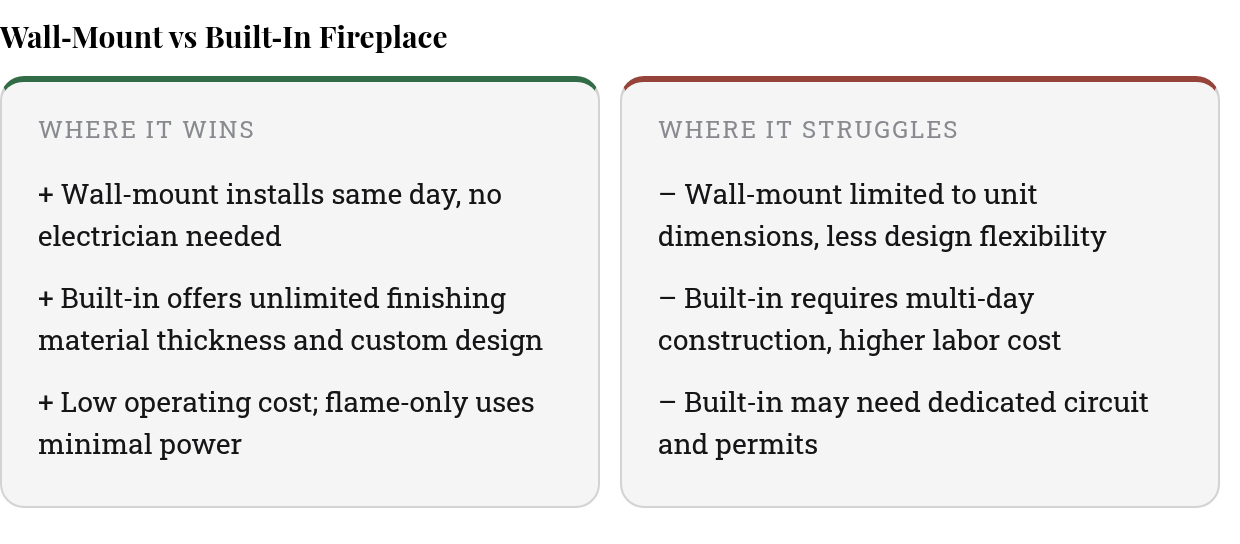
| Wall-Mounted Electric Fireplace | Built-In Feature Wall (Standard) | Custom Built-In with Electric Fireplace |
|---|---|---|
| Upfront Cost | Varies by model and features | Varies by size and finishes |
| Installation Time | Minimal for plug-in models; hardwired units require electrician work | Typically requires framing and finishing |
| Electrical Work | Plug-in models use standard outlet; hardwired units need dedicated circuit | None unless adding outlets or lighting |
| Running Cost | Low operating cost; flame-only mode uses minimal power | None |
| Design Flexibility | Mounts to any wall surface; limited to unit dimensions | Full control over size, materials, shelving, and layout |
| Removal/Reversibility | Unplug and unmount quickly | Demolition required to remove framing |
What Electric Fireplace Pricing Tells You
Electric fireplace pricing varies by size, flame technology, and whether the unit is plug-in or hardwired. Mid-range units cover most standard sizes with premium flame effects.
Heat & Glo’s recessed models include options like the Allusion Platinum and the Scion. The fireplace price covers the unit only. Installation costs layer on top, though most plug-in models require no professional labor.
A standard built-in feature wall varies by size and finish. Combining that wall with a recessed electric fireplace increases the project cost when you factor in custom tile, stone, or millwork.
Installation Time and Electrical Load
Hardwired units or new dedicated circuits typically take a few hours. Plug-in models need no electrician at all.
A built-in feature wall without a fireplace takes a few days for framing and finishing. Add a recessed fireplace and the timeline extends, depending on how custom the finishes run. Built-in models like the Scion have no restrictions on finishing material thickness, so you can finish stone or tile right up to the viewing area, unlike surface-mounted models that read more like an appliance.
Most electric fireplaces draw more power on heat mode and less for flame-only operation. Running costs stay low. Tampa’s humid climate can make the electric option more practical than gas, since gas installations here may require extra venting infrastructure and corrosion-resistant lines.
What You Should Know Before You Pick
- Wall-mounted electric fireplaces are the fastest path if you want the look without major construction.
- Hardwired or recessed installations require more planning. In older Tampa homes, wall depth, electrical access, and panel capacity all affect the final scope.
- A standard built-in feature wall gives you the most control over shelving, proportions, surface materials, and the overall room design.
- Recessed electric fireplaces pair well with tile, stone, drywall, or millwork when you want the fireplace to feel integrated instead of surface-mounted.
- In Tampa, electric fireplaces often make more practical sense than gas when the goal is year-round ambiance with occasional supplemental heat.
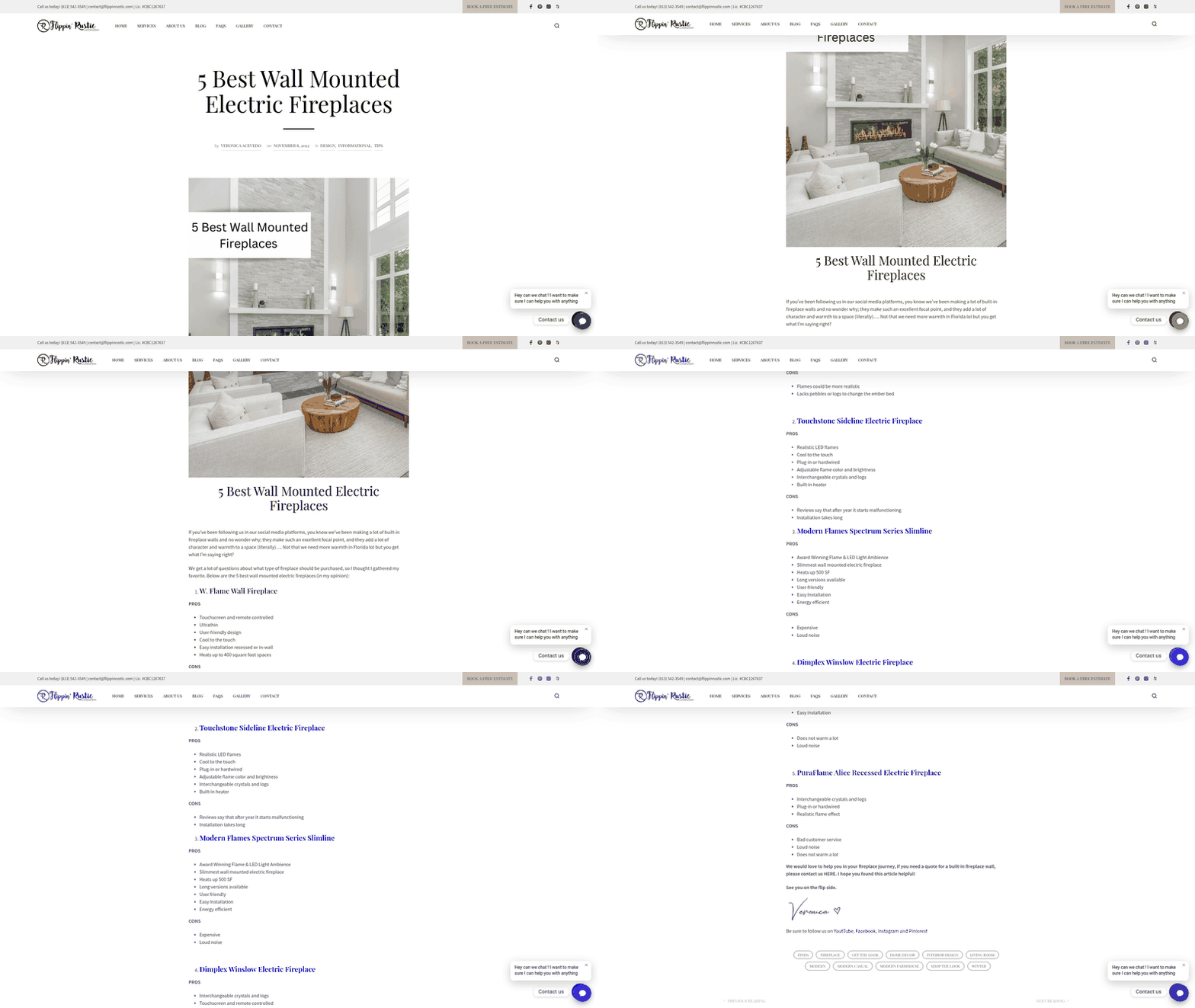
Wall-Mounted Electric Fireplace
A wall-mounted or recessed electric fireplace gives you a contemporary linear design that fits almost anywhere. These units work well when you want clean lines and a low-profile look, whether you’re mounting one above a console in the living room or building it into a bedroom accent wall.
Entry-Level and Mid-Range Models
Electric fireplaces can be installed on the wall surface or recessed into an opening, depending on the model. Surface-mounted models read more like an appliance or media feature. Recessed models become part of the wall. Some units come standard with crystal or stone media, and you may be able to upgrade to a driftwood log set if you want a more textured look.
Electrical Load and Installation
Heat mode can trip a shared circuit in older homes. Larger units or hardwired installations may need a dedicated circuit run from your breaker panel, which adds to the installation cost depending on distance.
Wall-mounted models that bracket onto the wall and plug into a nearby outlet keep the project simple. Built-ins need framing, and some may need hardwiring. We tell Tampa clients to check wall depth and panel capacity before committing to a hardwired or recessed unit, especially in older homes where the panel is already near its limit.
These units work best as supplemental heat and visual ambiance, not as the only heating source for the home.
Built-In Feature Wall
A built-in feature wall with an electric fireplace sits flush with your wall rather than hanging on the surface. We frame an opening to the manufacturer’s size and depth specs, slide the unit in, and finish the surrounding surface so the fireplace feels planned with the room. The result is more architectural than a bracketed wall unit.
What the Framing Work Involves
Most units need a framed opening that matches the unit’s exact dimensions. Standard 2×4 wall framing is enough for many models, though deeper units sometimes call for 2×6 framing or a bumped-out section if you’re working with an existing wall. For older Tampa homes, check the actual wall depth before choosing a recessed model. The finished wall can then be designed around the fireplace with shelving, panels, tile layouts, or a cleaner drywall surround.
We check the manufacturer’s installation manual for clearances around the unit. That spacing protects the unit and keeps heat from building up inside the wall cavity. Skip this step and you risk voiding the warranty or creating a fire hazard.
Electrical Load and Circuit Requirements
Whether your room already has a convenient outlet or needs new wiring depends on where you want the fireplace and what the manufacturer’s specs call for. Some built-in models can plug into an existing outlet if it’s close enough; others may need a new circuit run from your panel.
Some built-in models require hardwiring instead of a plug connection. Hardwired setups keep the cord hidden and meet code for certain recessed installations, but they add electrical labor to the install cost.
We always check what’s already in the wall before planning circuit work. If the room’s on a shared circuit with multiple outlets or lighting, the fireplace may pull enough power to create nuisance breaker trips when other devices run at the same time.
Cost, Timeline, and Value Comparison
When you’re weighing a wall-mounted electric fireplace against a custom built-in feature wall, installation work is where electric fireplaces pull ahead when the model is designed for a simple outlet connection. Built-in or hardwired setups change the equation because they can involve dedicated circuit work, custom framing, finish carpentry, tile, or stone.
Running Cost and Electrical Load
Operating an electric fireplace with the heater active uses more power than running the visual flame effect alone, which matters because many Tampa homeowners want the glow and design presence more often than they want extra warmth.
In Tampa’s climate, you’re more likely to use the fireplace as a visual feature for most of the year. A custom feature wall with hardwired lighting and built-in shelving may add visual impact, but it won’t add heat. If you want both, combining a built-in electric fireplace with the feature wall gives you a finished look with the option to add supplemental warmth when you need it, without the venting or gas-line considerations that can complicate other fireplace types in Florida’s humid climate.
Safety, Maintenance, and How to Pick
Budget, design goals, and timeline should guide the decision before you start shopping.
Budget and Timeline
A plug-in wall-mount unit keeps the project closest to a furniture or décor purchase: choose the model, confirm the outlet location, mount it securely, and connect it. A built-in setup with custom framing, hardwiring, and a dedicated circuit adds labor and materials. If you’re hiring an electrician to run new wiring or a carpenter to frame the opening, expect additional costs and time.
Ongoing use is usually modest either way, especially when the fireplace is mostly for ambiance. That’s one reason electric pulls ahead in Tampa’s climate: you get the look without committing to a heat-heavy system you may rarely need.
Electrical Safety Checklist
Before you commit to any model, confirm the unit’s wattage and whether it needs a dedicated circuit. Larger units may require a dedicated 20-amp circuit run from your breaker panel. That work adds to the project cost and should be planned before the wall is finished.
Check whether the model is plug-in or hardwired. Plug-in units give you flexibility to move or replace them later. Hardwired setups look cleaner but lock the fireplace into that wall opening. If you’re hardwiring, plan for additional electrician time.
Tampa homeowners also need to verify whether local permitting or inspection applies. Hillsborough, Pinellas, and Pasco Counties each have their own rules for electrical work. A dedicated circuit usually triggers a permit requirement, while a simple plug-in wall mount typically doesn’t. Call your local building department before the electrician starts if you’re unsure.
Decision Checklist: Which Option Fits Your Home
| Priority | Wall-Mount (Plug-In) | Built-In Feature Wall |
|---|---|---|
| Budget | Lowest upfront cost | Higher labor, materials |
| Timeline | Same-day install | Multi-day project |
| Design flexibility | Can be moved or replaced | Permanent, flush finish |
| Finishing options | Limited to unit trim | Unlimited material thickness—tile, stone, wood |
| Electrical work | Standard outlet | May need dedicated circuit |
If you’re working with a tight budget or a rental property, the wall-mount route makes sense. If you’re renovating a living room and want a cohesive, high-end look, a built-in feature wall paired with the right finishing materials delivers a result that reads as original to the home rather than added later.
References
[1] Built-In vs Wall-Mounted Electric Fireplaces – https://www.theelectricfireplaceshop.com/blogs/news/built-in-vs-wall-mounted-electric-fireplaces-the-electric-fireplace-shop?srsltid=AYCX9vIYnvqw14h14hNrHXsZ8KinX5f2IEKCJgEJ4gGcutPn1zzAgrv4
[2] Buying Guide: Recessed Electric Fireplaces – Heat & Glo – https://www.heatnglo.com/ideas/recessed-electric-fireplace-buying-guide
[3] Electric Fireplace Installation Cost | How Much is it to Install One? – https://thegreatfirecompany.com/blogs/learning-center/electric-fireplace-installation-cost?srsltid=AYCX9vJt4CIYF84ha5ldrtKbi-gbXY0k3aLWo9fB6egnjJz5LEj5fFrA
Common Questions
1. Can I install a wall-mounted electric fireplace myself or do I need to hire someone?
If the model is designed to hang on a bracket and connect to an existing outlet, many homeowners can handle the basic installation themselves. Hire an electrician when the unit must be hardwired, when the outlet location is wrong, or when the manufacturer specifies a dedicated circuit.
2. Will running an electric fireplace in Tampa actually raise my electricity bill significantly?
For most Tampa homeowners, the cost impact depends on how often the heater is used versus the visual flame setting. Since many people use these fireplaces mainly for atmosphere, the ongoing expense is usually modest compared with systems that rely on gas lines, venting, or regular heat output.
3. What happens if I want to remove or relocate a built-in electric fireplace later?
Built-in units require demolition of the surrounding framing and finished materials to remove, which means you lose the tile, stone, or drywall work around the opening. The fireplace unit itself can usually be salvaged and reinstalled elsewhere, but you’re starting the framing and finishing work from scratch in the new location.